
Views: 0 Author: Site Editor Publish Time: 2026-07-27 Origin: Site


Industrial dust collection systems battle extreme conditions daily. Sustained high temperatures often destroy standard filtration media quickly. Abrasive particulate loads accelerate this physical breakdown further. Facilities frequently experience premature media failure due to these aggressive environments. This failure leads directly to serious emission compliance breaches. Unplanned downtime quickly follows, heavily eroding overall facility profitability.
Finding the right fabric to withstand aggressive environments remains difficult. You need materials capable of handling extreme heat without falling apart. We introduce the P84 filter bag as a specialized, premium solution. Engineers design it specifically for these severe industrial environments. It serves as an exceptionally effective thermal resistant filter media. However, its success depends entirely on proper application. You must carefully match its unique structural properties to your specific chemical baseline. You also need to verify your thermal operational limits. We will explore its technical architecture, direct benefits, and ideal industry matches below.
P84 filter bags utilize a unique tri-lobal fiber structure that promotes surface filtration, reducing pressure drop and energy costs.
They maintain structural integrity at continuous operating temperatures up to 260°C (500°F).
While highly resistant to acids, P84 media requires strict evaluation of exhaust gas moisture and alkalinity to prevent hydrolysis degradation.
Typical ROI is realized in cement kilns, waste-to-energy incinerators, and asphalt plants where standard media fail to meet emissions or lifecycle targets.
Business leaders often overlook the hidden costs of inadequate media. High-heat applications heavily punish weak filter bags. Frequent changeouts drain maintenance budgets rapidly. Maintenance crews spend days replacing torn bags instead of performing preventive care. Lost production time limits your overall revenue significantly. Furthermore, blinding increases fan energy consumption. When dust embeds deep within poor media, it blocks airflow. Your induced draft fans must work harder to pull air through clogged bags. This extra work consumes massive amounts of electricity.
Tightening particulate matter (PM) emission standards pose huge compliance risks. Regulatory bodies monitor stack emissions closer than ever. Filter bypass occurs when bags develop small pinholes. Structural tears release visible dust plumes into the atmosphere. These failures result in heavy financial penalties. They can also force mandatory plant shutdowns.
Standard polyester or fiberglass bags often fail here. You cannot rely on them for aggressive, chemical-laden dust streams. Polyester melts quickly under high heat. Fiberglass handles heat well but remains incredibly brittle. They lack either the chemical resistance or the flex-fatigue durability required. This gap leaves plant managers searching for a more resilient alternative.
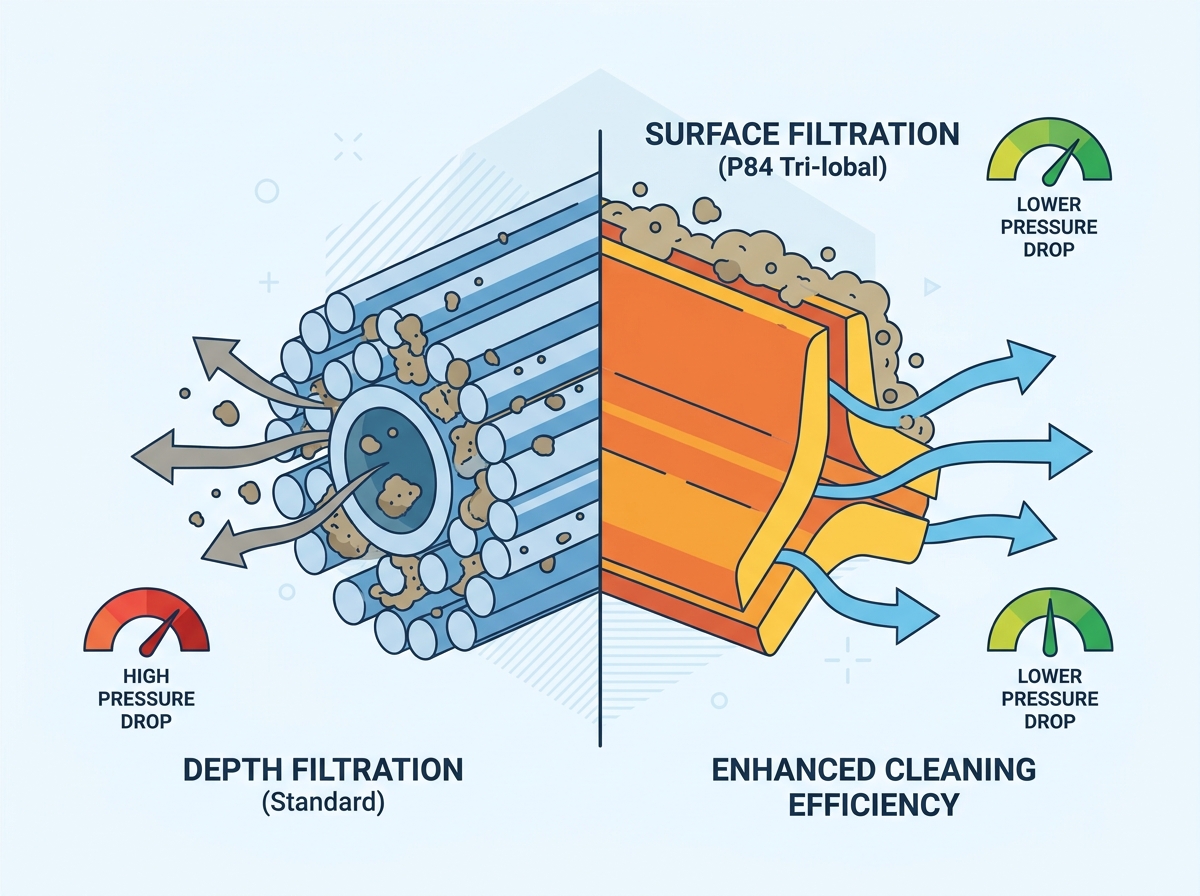
The foundation of this media lies in advanced polymer chemistry. Evonik originally developed the P84 polyimide fiber for extreme environments. We avoid academic jargon, but you must understand its baseline properties. Polyimide offers remarkable stability under intense heat. It does not melt or drip when exposed to high temperatures. The fiber retains its mechanical strength even in harsh conditions.
The tri-lobal cross-section defines its physical uniqueness. Traditional fibers feature a standard round shape. Polyimide fibers look more like a three-leaf clover under a microscope. This multi-lobal shape drastically increases the available surface area. It creates a much denser filtration barrier compared to round fibers.
This shape drives the transition from depth to surface filtration. Surface filtration stops dust on the exterior of the bag. It forms a highly permeable, superior dust cake. Particles do not embed deep into the media structure. Depth filtration, conversely, allows fine dust to penetrate and clog the fabric. Surface filtration keeps the airflow pathways open and efficient.
Thermal thresholds firmly establish it as a top-tier thermal resistant filter media. You can run these bags safely at a continuous operating temperature of 260°C (500°F). They also tolerate brief peak surges slightly above this limit. This exceptional heat tolerance prevents catastrophic meltdowns during unexpected process upsets.
Efficient surface filtration heavily reduces the workload on your system. It actively lowers the differential pressure drop across your baghouse. This directly cuts electricity operating expenses. Induced draft fans consume the bulk of dust collection energy. Lower pressure drops allow you to run fans at lower speeds. This adjustment saves thousands of dollars annually in power costs.
You also gain enhanced cleaning efficiency. The irregular fiber shape allows dust cakes to release much more easily. During pulse-jet cleaning, the dust sheds in large, unified sheets. This means you need fewer cleaning pulses. You save significant compressed air usage over the operational lifecycle.
Flex-fatigue resistance offers another massive advantage. Pulse-jet cleaning violently snaps filter bags against their metal support cages. You can contrast the flexibility of polyimide with the extreme brittleness of fiberglass. Fiberglass snaps and frays after repeated flexing. Polyimide bends and recovers without sustaining microscopic damage. This translates to fewer broken bags during aggressive mechanical cleaning cycles.
Reduced Energy Consumption: Lower differential pressure requires less fan power.
Optimized Cleaning Cycles: Better dust cake release minimizes compressed air usage.
Extended Lifespan: High flex-fatigue resistance prevents mechanical tears.
Stable Emissions: Surface filtration prevents fine particle bleed-through.
You must evaluate alternatives before committing to a filtration upgrade. Different materials solve different chemical and thermal problems. We compare polyimide against other common high-temperature fabrics below.
PTFE serves as the gold standard for universal chemical resistance. It ignores practically all acids and alkalis. However, PTFE is significantly more expensive. It also suffers from much lower tensile strength. A P84 filter bag offers much better filtration efficiency at a lower price point. As long as your gas chemistry aligns, it provides better mechanical durability than pure PTFE.
PPS handles challenging chemical environments quite well. However, PPS has much lower temperature limits, maxing out around 190°C (375°F). Furthermore, PPS remains highly vulnerable to oxidation. If your oxygen levels exceed 8-10%, PPS degrades rapidly. Polyimide handles high oxygen environments easily without oxidizing.
Fiberglass is inexpensive and handles extremely high heat. Many budget-conscious facilities choose it first. Unfortunately, fiberglass fails quickly from flex-fatigue. The glass fibers break under continuous pulse-jet cleaning. Polyimide offers superior durability and a self-supporting structure. You get a much longer lifespan in mechanically aggressive systems.
We must explicitly state known vulnerabilities to ensure safe implementation. This media is susceptible to hydrolysis. Hydrolysis occurs in high-moisture environments combined with high heat. The chemical bonds of the polymer break down under steam. It also degrades quickly in highly alkaline environments. You must avoid this material if your gas stream is both hot and wet.
Media Type | Max Continuous Temp | Flex-Fatigue Resistance | Oxidation Resistance | Hydrolysis Resistance |
|---|---|---|---|---|
P84 (Polyimide) | 260°C (500°F) | Excellent | Excellent | Poor |
PTFE | 260°C (500°F) | Fair | Excellent | Excellent |
PPS | 190°C (375°F) | Good | Poor | Excellent |
Fiberglass | 260°C (500°F) | Poor | Excellent | Excellent |
This specific media excels in distinct, heavy industrial environments. We look for high temperatures paired with highly abrasive dust. It performs best where other materials physically tear apart.
Cement production generates highly abrasive dust. Clinker cooler exhausts push massive volumes of sharp particles. Flex-fatigue remains a primary concern in these baghouses. Fiberglass bags often shred themselves against their cages here. Polyimide aligns perfectly with this high-temperature, highly abrasive dust. It withstands the abrasion while handling the intense heat.
Incineration processes produce varied and aggressive exhaust gases. Facilities burn different fuels daily, shifting the chemical profile constantly. Polyimide delivers excellent performance in environments with varied acidic gas profiles. You must monitor the system carefully, however. It works brilliantly so long as you actively manage alkaline and moisture parameters.
Asphalt plants process large loads of rock dust and sand. Smelters deal with ultrafine metallic particulates. Both facilities demand maximum airflow for production. We highlight this media's ability to handle fine, abrasive particulate. It captures the dust effectively while keeping pressure drops exceptionally low. This ensures uninterrupted high-volume production runs.
You cannot simply swap out old bags and expect perfect results. Upgrading your system requires careful mechanical and chemical planning. Follow these crucial steps before placing your order.
Filter bags require internal metal cages for support. Standard polyester bags often use 10-12 wire cages. Upgrading to a premium polyimide fabric requires ensuring perfect filter cage conditions. We strongly recommend upgrading to 20-wire cages. More vertical wires provide adequate support. This tighter spacing prevents excessive flexing wear during cleaning pulses. It stops the fabric from stretching too far.
You can modify the base media to improve specific weaknesses. Manufacturers offer several hybrid options today. You might consider blending polyimide with PTFE fibers. You could also request a PTFE membrane lamination. These treatments effectively mitigate moisture risks. They dramatically improve the overall chemical resistance of the bag.
Never guess your operational parameters. We recommend comprehensive baseline testing of your exhaust gas chemistry. You must measure the exact temperature and humidity. You need to record O2, SOx, and NOx levels accurately. Complete this audit before committing to procurement. This data ensures you do not expose the bags to rapid hydrolysis.
The P84 filter bag represents a high-performance investment for serious operations. Engineers designed it specifically to solve high-heat and high-abrasion problems. Its unique tri-lobal structure promotes efficient surface filtration. This directly lowers your overall energy consumption and routine maintenance costs. When applied correctly, it drastically reduces unexpected downtime.
Take action by evaluating your current operational data. Consult with a dedicated filtration specialist to arrange a thorough gas stream analysis. Request a performance comparison audit for your specific baghouse environment. Verify your moisture and alkaline levels today to see if this upgrade fits your facility.
A: It allows continuous operation up to 260°C (500°F). It can handle short-term surges slightly higher than this limit. However, the exact maximum temperature remains highly dependent on your specific exhaust gas chemistry.
A: High pressure from pulse-jet cleaning is well-tolerated due to high tensile strength. However, high moisture poses a strict risk of hydrolysis, especially with heat and chemicals. You may require alternative media or PTFE blends for wet conditions.
A: It maximizes the filtration surface area significantly. This unique shape creates a highly efficient barrier that keeps fine dust on the exterior of the bag. This enables easier cleaning and maintains a lower pressure drop.
A: Standard polyester is strictly limited to approximately 135°C (275°F). P84 is explicitly designed for harsh industrial processes exceeding standard temperature thresholds. Standard polyester would instantly melt or degrade in these severe conditions.