
Views: 0 Author: Site Editor Publish Time: 2026-07-03 Origin: Site


Industrial air quality management demands proactive planning. A baghouse filtration system is not merely an optional utility. It stands as critical facility infrastructure. It dictates production uptime, workplace safety, and strict environmental compliance. However, plant engineers often face a significant buyer challenge during procurement. You must fully understand internal equipment mechanics to properly size the unit. Selecting the correct filter media prevents costly implementation errors. Ignoring these details causes sudden shutdowns. This guide bridges the gap between basic operational theory and technical procurement. We provide a transparent framework for evaluating equipment. You will learn how to shortlist a reliable dust extraction system for your specific plant needs. We explore intake mechanics, cleaning mechanisms, and filter media specification. You will also discover how to align performance standards. Finally, we uncover hidden operational pitfalls you must avoid.
Sizing is critical: The operational success of any baghouse filtration system hinges on an accurate air-to-cloth ratio tailored to specific particulate characteristics.
Cleaning mechanisms define application: Pulse-jet, reverse air, and shaker systems offer distinct advantages and trade-offs regarding continuous operation and mechanical wear.
Media selection dictates lifespan: Filter fabric must be specified based on operating temperatures, chemical exposure, and moisture levels, not just upfront cost.
Compliance is non-negotiable: Properly engineered systems actively mitigate NFPA combustible dust risks and ensure compliance with strict EPA emission limits.
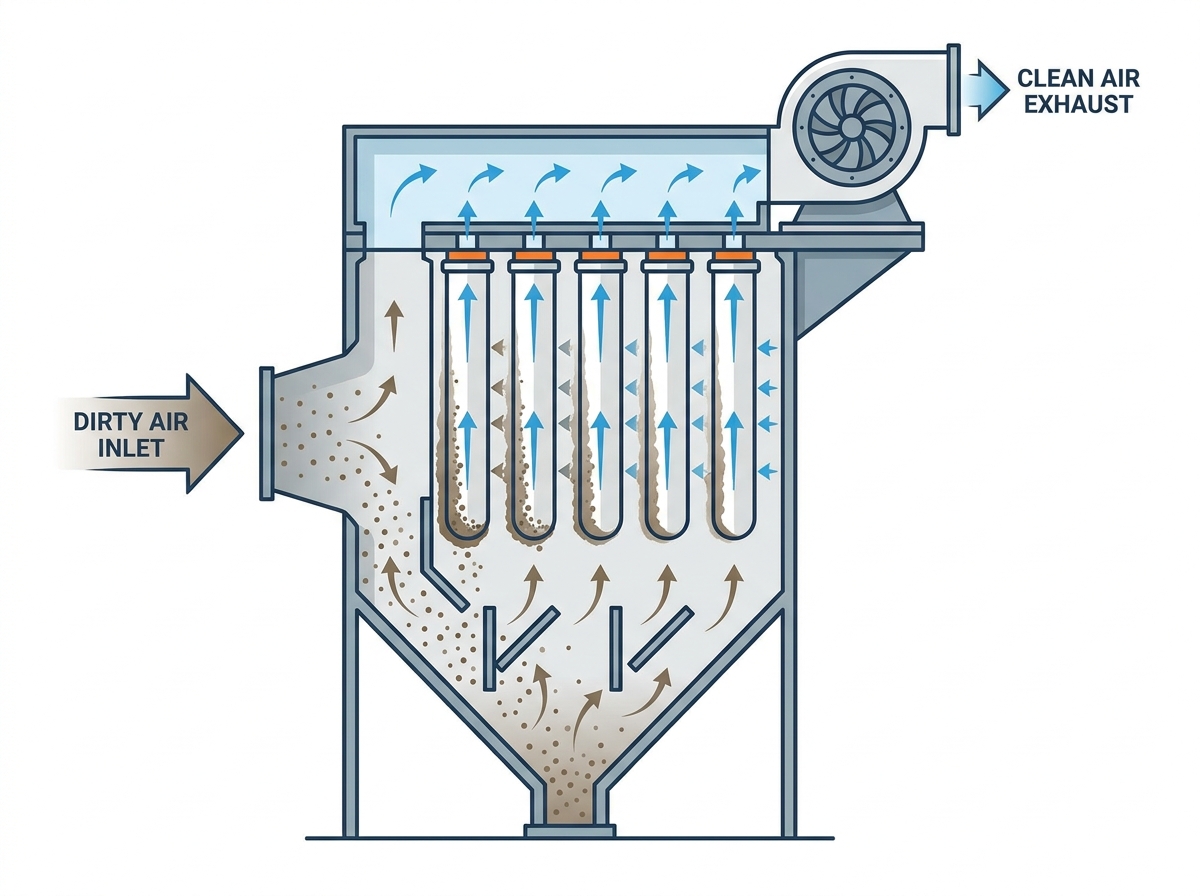
Particulate-laden air first enters the hopper or side inlet. The inlet design heavily influences internal airflow distribution. Internal baffles play a crucial role here. They act as physical barriers against the incoming air stream. The baffles redirect the airflow downward. They aggressively reduce the incoming air velocity. When velocity drops, gravity takes control. The heaviest particles cannot remain airborne at low speeds. They drop safely into the hopper below. We call this process pre-separation. Pre-separation prevents highly abrasive dust from striking the filters directly. It dramatically extends the physical lifespan of your filter media. It also reduces the overall dust load hitting the bags.
Air continuously flows through the filter bags. Systems use either outside-in or inside-out flow paths. Pulse-jet designs typically utilize outside-in flow. The dusty air hits the exterior fabric. Internal metal cages support the bags from collapsing. Reverse air units often use inside-out flow. The raw fabric itself does not perform the primary filtration. Instead, an initial dust layer forms on the fabric surface. Industry professionals call this the filter cake. The filter cake traps incoming fine particulates efficiently. The fabric simply acts as a substrate matrix. This stable dust cake drives high-efficiency performance. Without it, fine dust would bleed straight through the woven pores.
Clean air eventually enters the upper plenum chamber. A powerful industrial exhaust fan draws it out. You have two primary discharge options. You can vent this clean air into the atmosphere. Alternatively, you can safely recirculate it back into the facility. A broader dust extraction system handles this complex routing. Proper recirculation requires high-efficiency secondary HEPA filters. It significantly reduces facility heating and cooling expenses. You do not exhaust conditioned air outside. However, recirculating air demands strict safety monitoring. Abort gates must detect any filter leaks instantly.
Operators must monitor pressure drop across the filters continuously. We refer to this metric as differential pressure. It remains the primary diagnostic tool for system health. We measure this pressure in inches of water gauge. A newly installed bag might read one inch of resistance. A fully caked bag might read four to six inches. High differential pressure indicates severely blinded filters. Low differential pressure often indicates a torn bag. It heavily influences your main fan's energy consumption. High resistance forces the fan to work much harder. Monitoring this metric prevents unexpected catastrophic failures.
Cleaning Mechanism | Air Flow During Cleaning | Maintenance Complexity | Filter Wear Rate |
|---|---|---|---|
Pulse-Jet | Continuous (Online) | Moderate (Valves/Air Lines) | Moderate to Low |
Shaker | Interrupted (Offline) | Low (Mechanical Motor) | High (Physical Shaking) |
Reverse Air | Interrupted (Offline) | Moderate (Dampers/Fans) | Very Low (Gentle) |
Pulse-jet systems dominate modern industrial manufacturing applications. They rely on short bursts of compressed air. This compressed air shoots down into the bag. It rapidly expands the fabric outward. The sudden expansion fractures the accumulated dust cake. The shattered cake falls into the collection hopper. You gain massive operational advantages here. These systems clean the bags while running continuously. You do not need to shut down airflow during cleaning. A solid-state timer board controls the pulse sequence. However, you must supply highly reliable dry compressed air. Moisture inside the compressed air lines ruins the filter media.
Shaker mechanisms take a purely mechanical approach to cleaning. The filter bags hang from a specialized motorized rack. The motor aggressively shakes the entire rack assembly. This vibration forces dust to fall into the hopper below. These units offer much lower initial capital costs. They feature far simpler mechanical components than pulse-jet units. You do not need expensive compressed air infrastructure. However, you face a major operational trade-off. You must completely shut off airflow during the cleaning cycle. Continuous plant operation requires complex compartmentalized designs. Furthermore, aggressive physical shaking accelerates wear on the filter bags.
Reverse air units utilize very gentle cleaning methods. The system temporarily reverses the clean air flow direction. This backward airflow gently collapses the filter bag. Internal metal rings prevent the bag from collapsing entirely. The gentle flexing motion effectively dislodges the dust cake. We highly recommend this mechanism for extremely high temperatures. It suits highly delicate filter media perfectly. Woven fiberglass bags require this gentle treatment to survive. These systems require a significantly larger facility footprint. They also operate at much lower air-to-cloth ratios. You need massive units to handle moderate airflow volumes.
Engineers must calculate the air-to-cloth ratio accurately. The A/C ratio represents air volume passing through one square foot of media. We measure this in cubic feet per minute (CFM). Aggressive ratios push too much air through small areas. High ratios lead to premature filter blinding. You will face frequent filter replacements. A well-calculated ratio ensures long-term operational stability.
Engineers typically choose between three primary fabric categories:
Polyester: This serves as the industry standard choice. It remains highly cost-effective for many plants. It performs exceptionally well in dry, ambient conditions.
Aramid (Nomex): Manufacturers build this material for extreme heat. It offers exceptionally high temperature resistance. It resists structural degradation during continuous high-heat operations.
PTFE (Teflon) Membrane: This option delivers ultimate high-efficiency filtration. It provides excellent dust release properties. It offers superior chemical resistance. However, it requires a significantly higher capital investment.
Hopper evacuation tools play a vital role. You must select rotary airlock valves or screw conveyors. Double dump valves also work well for specific applications. A critical rule exists in dust collection. You must never use hoppers for storage. Stored dust bridges across the hopper walls. It eventually backs up into the filter section. This causes immediate catastrophic system failure. Continuous evacuation protects your equipment.
Combustible dust management requires strict attention. System designs must strictly integrate NFPA safety standards. Combustible particulates pose severe explosion risks. You must install reliable explosion venting panels. Chemical suppression systems add another layer of safety. We also recommend spark arrestors within the dust extraction system. These components extinguish sparks before they reach the filter media. Ignoring combustible dust regulations leads to catastrophic facility disasters.
Properly engineered baghouses capture hazardous PM2.5 and PM10 particulates. Environmental agencies enforce strict emission limits globally. Compliance meets Title V air permit requirements. It also satisfies strict indoor air quality (IAQ) mandates. Protecting worker health remains a top priority. Capturing microscopic particulates prevents severe respiratory illnesses among plant personnel.
We strongly warn against under-sizing your equipment. Small systems cannot handle sudden dust surges. Under-sizing directly causes fugitive emissions inside the plant. Fugitive dust settles across the facility floor. It creates dangerous slip hazards and secondary explosion risks. Regulatory inspectors issue heavy fines for these compliance violations. Over-engineering your capacity provides a critical safety buffer.
Moisture and condensation destroy filter performance rapidly. The internal temperature must never drop below the dew point. Warm gas holds significant moisture levels. When it contacts cold steel, condensation forms instantly. Moisture immediately turns airborne dust into mud. Mud creates irreversible filter blinding. Standard cleaning cycles cannot remove sticky mud. You must invest in proper housing insulation. Hopper heaters also prevent internal condensation during winter months.
The collector represents only one part of the equation. Poor ductwork design destroys overall performance. Low duct velocity causes material to settle in pipes. Settled dust creates severe fire hazards. It also increases system static pressure. High static pressure severely overworks your exhaust fans. Engineers must calculate transport velocity meticulously. Standard dust requires velocities around 3500 to 4500 feet per minute. Proper duct design ensures particulates reach the collector safely.
Engineers must evaluate maintenance accessibility carefully. Top-load systems allow workers to change bags from clean-air plenums. Bottom-load systems require workers to enter the dirty housing. Bottom-load designs trigger confined space entry requirements. Confined spaces demand extensive safety protocols. You need air monitors and retrieval harnesses. These requirements significantly increase maintenance labor costs. They also extend facility downtime during changeouts. Top-load designs provide safer, faster maintenance experiences.
You must define several baseline metrics first. Gather accurate operational data before approaching vendors.
Required CFM: Determine the exact air volume needed to capture dust at the source.
Dust Loading Rates: Calculate the total weight of particulate entering the collector hourly.
Operating Temperatures: Document both average and peak temperature spikes during production.
Particulate Bulk Density: Measure how much the collected dust weighs per cubic foot.
Vendors need this specific data. It helps them design accurate engineering solutions.
Industrial dust collection rarely functions as plug-and-play. Every facility generates a unique dust profile. You must demand customized engineering drawings. Request explicit performance guarantees from the manufacturer. Off-the-shelf units often fail in rigorous industrial environments. Customized engineering accounts for specific material abrasiveness and volume surges. It protects your capital investment.
We highly recommend booking a professional facility audit. You should also request a particulate testing lab analysis. Lab tests reveal true dust abrasiveness and moisture content. Testing removes dangerous assumptions from the procurement process. It ensures you select the optimal filter media from day one. Reach out to a qualified testing laboratory to begin this process.
A baghouse filtration system functions as an integrated engineering solution. You should never treat it as an isolated commodity. Optimizing your cleaning mechanisms directly improves reliability. Selecting the correct filter media prevents constant maintenance. Sizing the unit accurately reduces excessive operational expenses and facility downtime. You must evaluate your distinct application parameters carefully. Do not rush the specification phase. Contact an engineering specialist today. They can analyze your specific dust profile and airflow requirements. Professional guidance ensures long-term operational success.
A: The ideal ratio varies wildly depending on your dust type and cleaning mechanism. Reverse air systems typically require a conservative 2:1 ratio. Pulse-jet units handling standard dry dust often operate efficiently at a 6:1 ratio. Heavy or highly abrasive dust loads always demand lower, more conservative ratios.
A: Filter bags generally last between one and three years. This lifespan depends heavily on your specific operating conditions. An aggressive air-to-cloth ratio drastically shortens their life. Proper moisture control and optimal cleaning cycle frequencies significantly extend filter usability. Regular differential pressure monitoring helps you maximize their exact lifespan.
A: Baghouses use long fabric bags. They filter heavy, abrasive, or high-temperature particulates effectively. Cartridge collectors use pleated synthetic cartridges instead. Cartridges offer a much larger surface area in a highly compact footprint. They work best for very fine, free-flowing dust. Cartridges degrade quickly in highly abrasive environments.
A: Differential pressure serves as the primary diagnostic indicator for your equipment. It measures the airflow resistance directly across the filter media. High differential pressure signals blinded bags or an overdue cleaning cycle. Monitoring it optimizes cleaning timing. It reduces unnecessary compressed air usage and lowers overall energy consumption.