Views: 0 Author: Site Editor Publish Time: 2026-08-02 Origin: Site


Industrial baghouses face accelerated filter degradation when high temperatures combine heavily corrosive flue gases. Dealing with these extreme conditions requires materials engineered for maximum resilience. Standard fabrics often fail dramatically under such intense thermal and chemical stress. Premature bag failure leads directly to costly downtime. Facilities then face non-compliance with emission standards and frequent replacement cycles. If you choose the wrong fabric, you risk shutting down operations entirely to replace melted or chemically destroyed filters.
We introduce the polyphenylene sulfide (PPS) material profile as an industry-standard solution for specific harsh environments. This material provides distinct advantages over basic polymers. We will provide an objective, technical evaluation of its capabilities and limitations. You will learn precise implementation strategies for your facility. These insights help you maximize filter lifespan. Ultimately, careful material selection ensures you maintain regulatory compliance while optimizing operational efficiency.
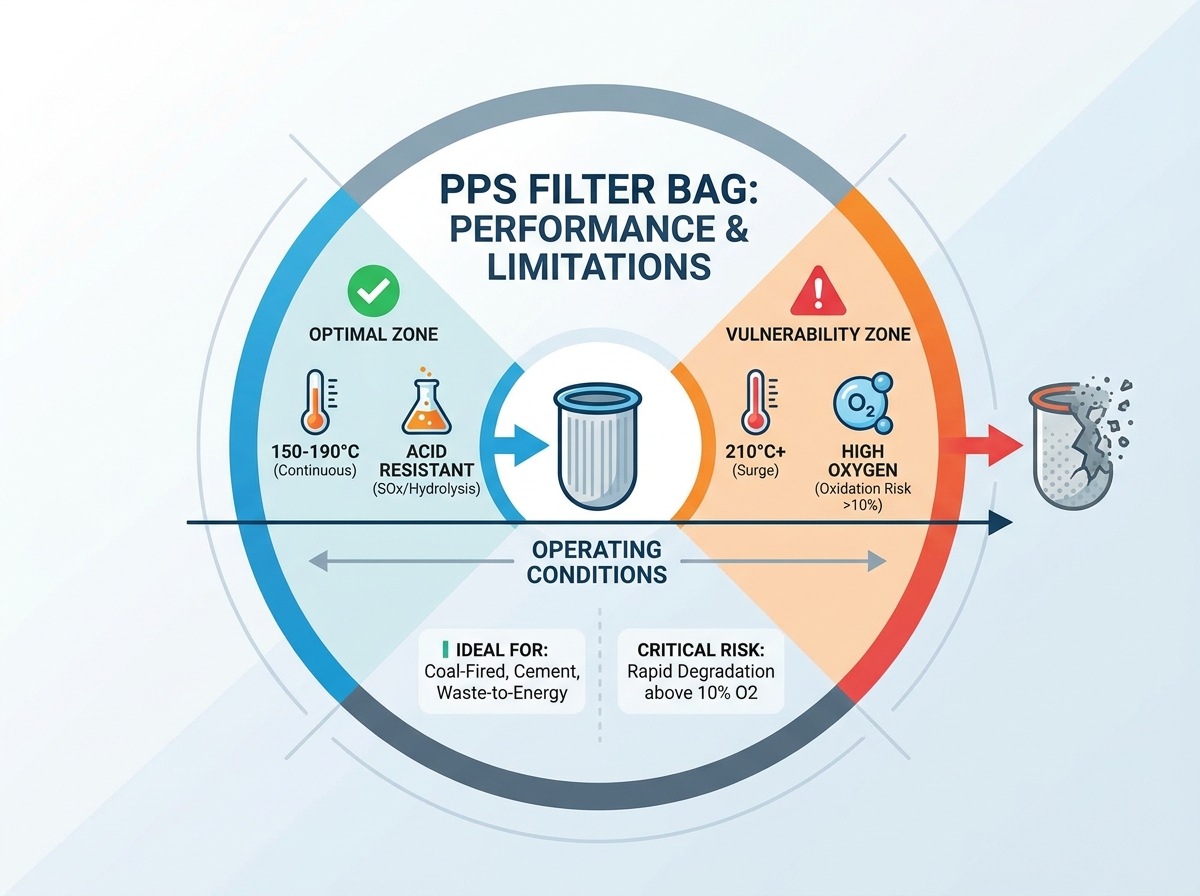
**Optimal Temperature Range:** Performs reliably at continuous operating temperatures up to 190°C (374°F) and withstands surges up to 210°C (410°F).
**Chemical Defense:** Exceptionally effective as an acid resistant filter bag, particularly in environments with high sulfur content (SO2/SO3).
**Primary Vulnerability:** Highly susceptible to oxidation; requires operating environments with oxygen levels strictly below 9-10% to prevent rapid degradation.
**Cost-to-Performance Ratio:** Offers a high-ROI middle ground between standard polyester and premium PTFE bags for coal-fired, cement, and foundry applications.
Engineers consistently encounter complex baseline problems in industrial filtration. Standard filter media melt, shrink, or degrade chemically when exposed to industrial boiler exhaust. Polypropylene and standard polyester fail rapidly inside incinerator systems. Extreme heat physically distorts basic fibers. Simultaneously, aggressive gas streams break down their molecular chains. These rapid degradation cycles force maintenance teams into constant, reactive replacement modes.
We must outline stringent success criteria for high-temperature filtration. First, thermal stability remains non-negotiable. The fabric must exhibit zero shrinkage during continuous operation. Second, chemical inertness provides crucial defense mechanisms. Materials need absolute resistance against hydrolysis and acid attack. Third, mechanical durability plays a vital role. The fabric must demonstrate exceptional flex fatigue resistance during rigorous pulse-jet cleaning cycles.
We introduce PPS as a specialized thermoplastic polymer engineered specifically to meet these overlapping criteria. Its molecular structure inherently resists thermal degradation. Designers created this material to thrive where traditional fabrics dissolve. Implementing a PPS filter bag solves multiple engineering hurdles simultaneously. It provides structural integrity alongside robust chemical shielding. This specific combination makes it indispensable for modern emission control frameworks.
We must rigorously document the specific temperature thresholds of this material. The fabric maintains stable continuous operation at 190°C. It safely absorbs brief peak surges up to 210°C. We observe how the strong polymer structure prevents dimensional shrinkage under continuous heat stress. The rigid aromatic rings within the molecular chain lock the fibers in place. This prevents the fabric from warping or blinding over time.
You can see why it excels as an acid resistant filter bag in highly corrosive sectors. We detail the material’s profound resistance to aggressive acids and alkalis. It highlights remarkable performance in flue gas desulfurization (FGD) systems. Sulfuric acid dew point condensation is a frequent risk in these environments. When gas temperatures drop, highly concentrated sulfuric acid forms on the filter surface. PPS repels these harsh chemical droplets effortlessly. It maintains its tensile strength where other polymers dissolve entirely.
Hydrolysis resistance forms another critical defense layer. We briefly contrast this capability against materials like Nomex (Aramid). Nomex suffers catastrophic failure when exposed to hot, wet environments. Steam breaks down Aramid fiber chains rapidly. Conversely, PPS demonstrates superior ability to withstand moisture combined seamlessly into heat. It undergoes hydrolysis without losing significant tensile strength. This makes it heavily preferred for high-moisture boiler applications.
Selecting the correct filtration media requires careful technical evaluation. Engineers must balance thermal limits, chemical defenses, and budget constraints. We analyze how PPS compares against other prominent high-temperature fabrics. Understanding these trade-offs prevents catastrophic baghouse failures.
We often evaluate the direct trade-off between these two popular materials. Nomex handles slightly higher temperatures comfortably. However, it remains highly vulnerable to moisture and sulfur. Hydrolysis and acid attack destroy Aramid fibers very quickly. PPS easily wins in wet, acidic environments. You should never deploy Nomex where sulfuric acid dew points occur.
This comparison reveals a significant operational trade-off. PTFE remains universally chemically resistant across the board. It also handles much higher heat levels safely. Unfortunately, PTFE is significantly more expensive and structurally weaker. Fibers flex and break more easily during pulse-jet cleaning. PPS provides much better mechanical strength at a substantially lower price point for sub-190°C applications.
We must look at the specific trade-off regarding filtration efficiency here. P84 offers slightly higher initial filtration efficiency. This happens due to its unique trilobal fiber shape. It also boasts a higher heat tolerance. However, P84 degrades rapidly in alkaline conditions. PPS proves far more universally chemically stable across variable gas streams.
Below is a summary chart mapping the operational matrix of these filtration media:
Filter Material | Max Continuous Temp | Acid Resistance | Hydrolysis Resistance | Mechanical Strength |
|---|---|---|---|---|
PPS | 190°C | Excellent | Excellent | High |
Nomex (Aramid) | 200°C | Poor | Poor | High |
PTFE | 250°C | Excellent | Excellent | Low |
P84 (Polyimide) | 240°C | Good | Fair | Moderate |
Every engineering material carries specific vulnerabilities. We must explicitly state the primary weakness of this polymer. Its most significant flaw remains severe oxidation. You must meticulously manage the gas stream composition. High temperatures combined directly excessive oxygen levels destroy the fabric. When oxygen levels rise above 9-10%, the fibers oxidize rapidly. They become highly brittle and fail catastrophically. You cannot ignore this parameter during system design.
We also acknowledge severe spark and ember risks. PPS is not naturally fireproof. You must plan for this limitation proactively. Discussing the absolute necessity of spark arrestors is critical. Applications like foundries or biomass boilers generate live embers constantly. Without physical spark arrestors, embers will easily burn through the fabric. Localized burn holes ruin filtration efficiency instantly.
We can outline specific mitigation strategies to protect the filter media. Manufacturers offer protective surface treatments for harsh conditions. PTFE glazing or surface singeing enhances the baseline filter lifespan significantly. These specialized treatments reduce surface friction against abrasive dust. They also shield the core fibers against initial chemical attacks. Implementing these upgrades maximizes your material investment safely.
Various heavy industries rely heavily on this specific polymer for emission control. Its unique balance of chemical resistance and thermal stability fits many industrial profiles perfectly. We detail how different sectors scale this technology for their specific challenges.
Coal-Fired Power Plants: This material serves as the universal standard here. It expertly manages high volumes of abrasive fly ash. Most importantly, it handles high-sulfur emissions efficiently without chemical breakdown.
Waste-to-Energy and Incinerators: Municipal waste exhaust presents severe challenges. The chemical makeup of the exhaust changes hourly. Facilities require a robust acid resistant filter bag to survive unpredictable acidic spikes.
Foundries and Metal Smelting: These operations generate intense heat and highly abrasive dust. Facilities address these threats using specialized filter setups. They note the strict requirement for precise temperature control and spark arrestors.
Cement Production: Managing kiln exhaust demands profound chemical resilience. The gas chemical composition fluctuates drastically during different production phases. PPS provides the stable chemical tolerance required for continuous operation.
Here is an operational suitability table highlighting industry-specific threats:
Industry Sector | Primary Exhaust Threat | PPS Performance Outcome |
|---|---|---|
Coal Power | High SO2 / SO3 & Fly Ash | Optimal; withstands acid dew point easily. |
Waste Incineration | Variable Acidic Gases | Strong; resists sudden acid spikes effectively. |
Foundry/Smelting | Abrasive Dust & Embers | Viable; requires upfront spark arrestor installation. |
Cement Kilns | Alkaline & Acid Fluctuations | Excellent; highly stable across pH ranges. |
Selecting the optimal filter requires a strict analytical approach. You cannot guess when dealing with extreme industrial exhaust. We utilize a definitive decision framework to guide procurement teams. Follow this checklist before making any purchasing decisions.
Is the continuous operating temperature precisely between 150°C and 190°C?
Are there significant moisture and acid gas (SOx, NOx) concentrations present?
Is the oxygen content of the flue gas consistently monitored below 10%?
We provide a clear outcome assessment based on your answers. If the answer to all three questions is "yes," this material is likely your best solution. It will provide exceptional durability and chemical defense. However, if O2 levels remain high, you must reconsider. If temperatures frequently exceed 190°C, guide your team toward PTFE or fiberglass alternatives. Ignoring these limits guarantees premature baghouse failure.
We strongly advise specific next steps for plant managers. You should consult directly alongside a certified baghouse engineer. Ask them to run a comprehensive flue gas analysis. Gather real-time data on temperature peaks, oxygen percentages, and moisture content. You must complete this verification step before finalizing any major procurement contracts.
We summarize the strategic value of this engineered polymer clearly. It strikes an exceptional balance between thermal resilience, acid resistance, and upfront budget constraints. You gain premium chemical defense without paying premium PTFE prices. This makes it highly attractive for power generation and incineration facilities.
We reiterate that careful environmental monitoring remains absolutely crucial. You must monitor O2 levels and temperature spikes continuously. This vigilance is the ultimate key to maximizing the lifespan of the filter media. Proper operation prevents oxidation and thermal degradation effectively.
We encourage you to audit your current baghouse gas composition immediately. Analyze your latest emission reports thoroughly. Request a technical consultation from a filtration specialist to verify material compatibility. Upgrading your filter media proactively protects your entire operation from unexpected downtime.
A: A standard bag typically lasts between two to four years in industrial settings. This average lifespan remains heavily dependent on precise O2 levels and cleaning cycles. High oxygen exposure or excessively aggressive pulse-jet cleaning will shorten this timeframe significantly. Proper monitoring ensures maximum longevity.
A: Yes, they perform well in foundry applications. However, this environment requires strict temperature regulation. You must install reliable spark arrestors upstream. Embers will cause localized burn-through rapidly without this critical physical protection.
A: A PTFE membrane or chemical treatment enhances dust cake release significantly. It also adds a slight physical barrier against initial chemical attack. This treatment reduces surface friction and protects core fibers. These operational benefits easily justify the premium upfront cost for demanding applications.
A: The fabric generally handles brief surge limits up to 210°C safely. However, sustained operations above 190°C accelerate degradation. The actual physical melting point of the polymer occurs around 285°C. You should never operate near these extreme thermal boundaries.