
Views: 0 Author: Site Editor Publish Time: 2026-07-11 Origin: Site


Frequent filter bag replacement is rarely just a standard maintenance expense. You should view it as a critical warning sign. It often indicates a systemic mismatch between your filtration media and actual process conditions. Facilities face escalating costs from unplanned downtime when dust collectors fail. High differential pressure drives up energy consumption. Fans must work much harder to move air through blinded media. Strict environmental regulations also mean emissions leaks carry severe compliance risks.
We will explore how to correctly diagnose baghouse failures. You will learn to match technical fabric specifications to your facility's realities. We will guide you through evaluating replacement solutions based on verifiable performance data. Upfront price alone does not determine true value. By identifying the root cause of failures, you can implement lasting improvements for your operations.
Premature failure of baghouse filter bags is rarely a product defect; it typically stems from misaligned fabric properties, chemical attacks, or mechanical wear.
High differential pressure (blinding) and emissions leaks require distinct diagnostic approaches before selecting a replacement solution.
Evaluating new industrial air filtration media requires looking beyond upfront cost to assess thermal tolerance, chemical resistance, and membrane technologies (e.g., ePTFE).
Successful implementation relies heavily on precise bag-to-cage fit, proper installation tension, and recalibrating cleaning cycles.
Failing media creates immediate operational bottlenecks. Excessive differential pressure reduces overall fan efficiency. The system requires more amperage to draw the same volume of air. This directly drives up your facility's energy costs. Reduced airflow also restricts overall plant production capacity. Dust collection points lose suction. Airborne particulate then accumulates inside the production area. You must slow down manufacturing lines to compensate.
Compliance and safety risks quickly follow operational bottlenecks. Regulatory agencies monitor stack emissions closely. The EPA or local environmental boards penalize emissions exceedances heavily. Failing media allows hazardous particulate to escape into the atmosphere. Internal dust accumulation presents severe occupational hazards. Combustible dust build-up violates OSHA and NFPA safety standards. Facility managers cannot ignore these severe safety liabilities.
We must map the compounding costs of these failures. The total cost of failure extends far beyond the price of replacement media. You pay expensive labor rates for emergency changeouts. Lost production time costs thousands of dollars per hour. Potential compliance fines add another layer of financial risk.
Expense Category | Direct Impact | Hidden Financial Drain |
|---|---|---|
Replacement Media | Purchasing new bags and cages. | Expedited shipping fees for emergency stock. |
Maintenance Labor | Paying crews to perform changeouts. | Overtime wages for weekend or night shifts. |
Energy Consumption | Higher electricity bills. | Premature wear on fan motors and drives. |
Lost Production | Process lines shut down. | Missed delivery deadlines and lost revenue. |
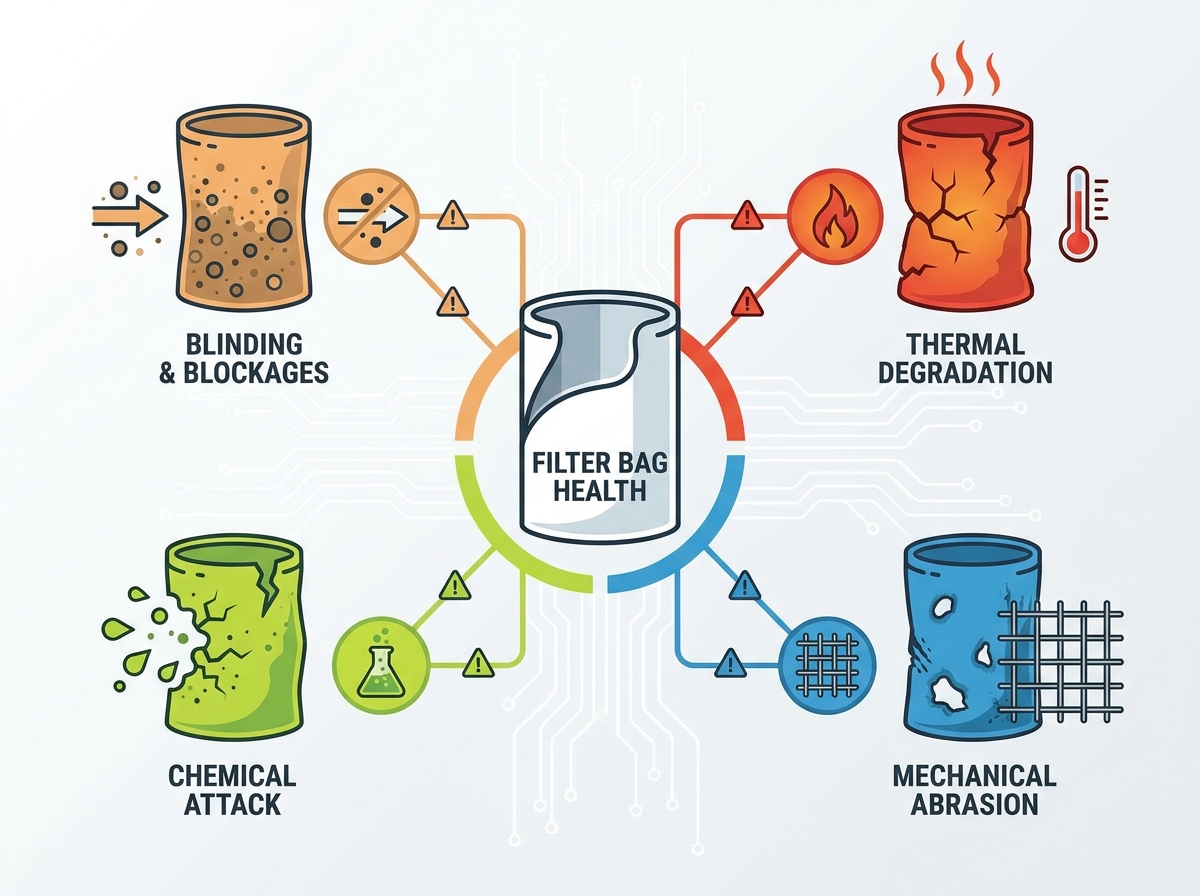
Proper diagnosis separates a permanent fix from a recurring nightmare. You must identify exactly how the media failed. We categorize failures into four primary modes. Each mode requires a specific investigative approach.
Blinding happens when dust embeds deeply inside the fabric. The media loses all permeability.
Symptoms: You will see a rapid increase in pressure drop. The cleaning mechanism completely fails to dislodge the dust cake. Airflow drops to unacceptable levels.
Root Causes: Moisture intrusion is the most common culprit. Water vapor causes dust agglomeration. The dust turns into a sticky paste. Undersized dust collectors also force particles deeply into the fabric. Ineffective pulse-jet or shaker operations fail to clean the media properly.
High temperatures destroy standard fabrics quickly. Heat alters the chemical structure of the polymer.
Symptoms: The fabric exhibits severe brittleness. You might notice extreme shrinkage. Sudden catastrophic tearing occurs during normal cleaning cycles. The bags look charred or melted.
Root Causes: Operating temperatures exceed the fabric’s continuous limits. Sometimes, brief temperature surges destroy the media. Spark arrestors fail to stop glowing embers. Hopper cooling systems malfunction. You must monitor peak temperatures closely.
Chemical attacks weaken the fibers at a microscopic level. The damage often looks invisible until catastrophic failure occurs.
Symptoms: The media suffers a complete loss of tensile strength. The fabric becomes powdery. It disintegrates easily when you touch it. Seams may fall apart completely.
Root Causes: Acidic or alkaline gas streams interact heavily with moisture. This triggers hydrolysis. Standard polyester breaks down rapidly via hydrolysis. High-moisture and high-heat environments accelerate these chemical reactions. Oxygen-rich environments degrade certain polymers through oxidation.
Physical wear and tear ruins perfectly good fabrics. Mechanical forces literally rub holes into the bags.
Symptoms: You will find holes near the bottom of the bag. Wear marks appear along the cage wires. Abrasions show up at the cell plate connections. The fabric looks fuzzy or frayed.
Root Causes: Poor bag-to-cage fit causes major issues. Bags fit too loose or too tight. Loose bags flap violently during cleaning. Excessive cleaning pressure accelerates flex-fatigue. Abrasive dust particles erode the fabric at high inlet velocities.
Replacing a failed bag with the exact same material is a mistake. It will only replicate the failure. You must engineer out the root cause. This requires selecting entirely new industrial air filtration media. We must match specific fabric properties to the operational challenges.
Different environments require highly specialized polymers. You cannot use a universal approach.
For High Heat: You should evaluate Aramid (Nomex), Fiberglass, or P84. Base your selection on peak temperature requirements. Fiberglass handles extreme heat but lacks flex tolerance. Aramid balances temperature resistance and durability.
For Chemical and Moisture Challenges: Utilize PTFE, PPS, or acrylics. These materials resist hydrolysis and severe acid attacks. PPS works beautifully in coal-fired boilers. PTFE offers the ultimate chemical resistance.
For Severe Blinding and Fine Dust: Assess the value of ePTFE membrane laminates. These membranes enable true surface filtration. They lower pressure drops significantly. Dust cake release improves dramatically. They capture sub-micron particles effectively.
Specific fabric treatments lead to measurable performance improvements. We connect manufacturing features directly to operational outcomes.
Singeing: Manufacturers burn off stray fibers. This creates a smoother surface. Dust releases much easier during pulsing.
Glazing: Heat and pressure melt the outer fibers slightly. This prevents fine dust from penetrating the felt.
Oleophobic Coatings: Chemical baths repel oils and moisture. These coatings prevent sticky dust from blinding the bags.
Fabric Type | Max Continuous Temp | Chemical Resistance | Primary Application |
|---|---|---|---|
Polyester | 275°F (135°C) | Poor against moisture/acids | General purpose, dry ambient dust |
Aramid (Nomex) | 400°F (204°C) | Good against alkalis, poor against acids | Cement, asphalt, high-temperature furnaces |
PPS (Ryton) | 375°F (190°C) | Excellent against acids and hydrolysis | Coal boilers, incinerators, power plants |
PTFE (Teflon) | 500°F (260°C) | Exceptional across all chemicals | Severe chemical environments, corrosive gases |
Selecting the right supplier determines your ultimate success. Do not just order from a catalog. You need a trusted technical partner. Ask specific questions before purchasing new baghouse filter bags.
Demand verifiable technical data sheets from your suppliers. You must scrutinize the exact specifications. Do they specify fabric weight properly? Ask for the air permeability rating measured in CFM. Check the Mullen burst strength to ensure mechanical durability. Verify the continuous and surge thermal thresholds. You cannot rely on marketing claims alone.
Assess the necessity of custom manufacturing. Standard off-the-shelf OEM replacements work for basic applications. However, harsh environments demand customization. You might need specialized snap bands for a tighter seal. Reinforced wear zones protect against abrasive inlets. Custom sizing prevents flex-fatigue on non-standard cages. Evaluate these options carefully.
Look for vendors offering thorough quality assurance. Trust vendors who perform material testing. They should offer lab analysis on your failed bags. A good partner diagnoses the exact failure mode before recommending a replacement. Avoid vendors who just quote a part number. You want engineering expertise, not just a transaction.
Provide a skeptical lens on cheap bags. Calculate your return on investment based on extended lifespan. Factor in reduced energy consumption from lower differential pressures. Cheaper bags often fail twice as fast. They drive up your electrical costs. Evaluating long-term financial impact proves far more accurate than looking at the per-bag unit price.
Even the best filtration media fails if installed incorrectly. Operational best practices dictate how long your upgrade lasts. You must control the implementation environment strictly.
Highlight the risk of cage compatibility immediately. Installing new bags on rusted cages destroys them. Bent cages cause uneven tension. Incorrectly sized cages lead to severe flex-fatigue. Abrasive rust acts like sandpaper against the fabric. You immediately void the value of a premium bag. Always inspect and replace damaged cages during changeouts.
Detail the absolute importance of installation integrity. Proper seating at the tube sheet prevents dangerous emissions leaks. Snap bands must snap loudly into place. Correct tensioning remains vital for shaker and reverse air systems. Loose bags wear out against themselves. Overtightened bags tear at the seams. Train your maintenance crews on proper seating techniques.
Advise on the necessity of system recalibration. New fabrics possess different air permeability rates. You must adjust your cleaning mechanisms accordingly. Change the pulse pressure to match the new media. Alter the dwell time and pulse frequency. Over-cleaning new bags destroys them quickly. Establish a brand new baseline for differential pressure. Do not rely on old timer settings.
Recommend instituting rigorous condition monitoring. Catching early wear patterns saves money. You should implement the following practices:
Conduct regular visual inspections of the clean air plenum.
Perform fluorescent dye-leak testing after every bag installation.
Log continuous pressure drop readings daily.
Monitor compressed air lines for unexpected moisture or oil.
Inspect hopper discharge valves to prevent material backup.
Resolving frequent baghouse issues requires a methodical, data-driven approach. You must diagnose the exact failure mode first. Stop guessing based on visual assumptions alone. Once you identify blinding, chemical attack, or mechanical wear, act decisively. Select a structurally and chemically appropriate filtration media. Upgrading your fabric technology eliminates recurring bottlenecks. It reduces energy consumption and secures environmental compliance.
We encourage facility decision-makers to take proactive steps today. Conduct a comprehensive failure analysis of your current bags. Do not wait for a catastrophic blowout. Request an expert site audit from a qualified technician. Schedule a technical consultation before procuring your next batch of media. A precise diagnosis combined with the right fabric ensures years of uninterrupted, highly efficient operation.
A: Lifespan varies widely and typically ranges from one to three years. It depends heavily on operational hours, dust abrasiveness, and chemical conditions. You should not rely on a set calendar date. Monitor your differential pressure and emission levels. Replace them when performance drops below acceptable baselines or mechanical degradation begins.
A: While dry cleaning or specialized laundering exists, we advise caution. Laundering often degrades the fabric's structural integrity. It frequently removes essential protective surface treatments like oleophobic coatings. Reusing bags acts as a short-term band-aid rather than a reliable long-term solution. Performance rarely returns to original specifications.
A: High pressure often points to systemic issues beyond the bags themselves. You might have incorrect pulse-jet timing or insufficient cleaning pressure. Blinded ductwork restricts overall airflow. Moisture in the compressed air lines causes immediate dust agglomeration. You may have also selected a fabric possessing incorrect air permeability for your specific application.